

EL RODRIGUILLO DISTRICT
District mayor: Montserrat Rico Pérez
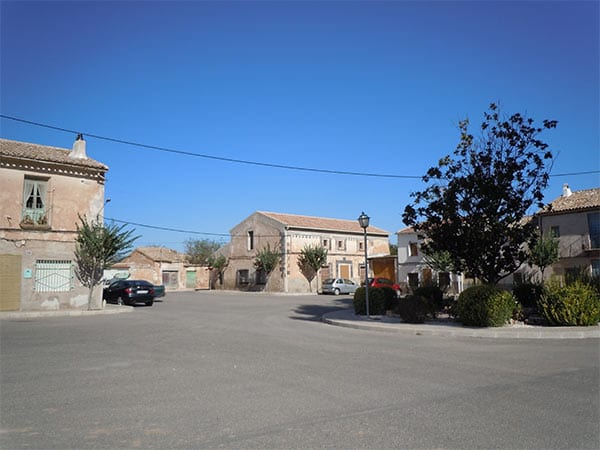
The district of El Rodriguillo is, we can say, the most significant of all those that form part of the Pinoso municipal territory. Its proximity to the urban center, at 3.3 km, is causing many young people to choose it to live in recent years. Houses that have been closed for a sufficient amount of time are recovering their lively appearance, although some are undergoing remodeling. It is a palpable sign that people are looking for tranquility. The district well exceeds one hundred inhabitants, distributed between the main nucleus and several areas and hamlets, among which we must highlight El Prado, La Teulera, and El Faldar, although there are other smaller ones that also structure the district’s territory, such as the Casas del Altet, the Fabriqueta, the Casas de Collado, those of Altet, the Casas Calpena, those of Pascualetas, or the Casa del Alfaquí, which has a name that sounds strongly Arabic.
In 1965, 294 residents lived in El Rodriguillo, but people left in search of work in the footwear industry, emigrating to Elda, Elche, or Novelda, in pursuit of a better life.
The district is located at an altitude of 450 m, in the southern area of the municipality and on the southwestern slope of the Cabeço de la Sal.
It is one of the most active districts, counting on two neighborhood associations: one in the hamlet of El Faldar, which is the most recent, and another called “El Progreso,” which is the oldest of those in our districts.
Both in El Faldar and El Rodriguillo, they have social venues where they meet and carry out activities; the one in El Rodriguillo was opened in 1995, while the residents of El Faldar inaugurated theirs in the year 2000.
In 1977, drinking water arrived in the district, and in 1980, the public lighting was renovated; more recently, at the end of the 20th century, a sewage treatment plant was built and the streets were urbanized.
Previously, the district had two schools, one for boys and one for girls, but in 1975, the Ministry of Education closed them and provided school transport and a dining service so that the children from rural areas could study in educational centers in Pinoso.
This marked the end of the district schools, where itinerant teachers used to go around teaching the rural population.
There is also nothing left of those small orchestras that entertained people with their dance sessions, as forms of entertainment have changed greatly, and it is easier to travel elsewhere due to transport improvements.
Those dances were held in the two existing bars, in El Rodriguillo itself and in El Faldar, run by Anselmo Jover and Hermelando Pérez, respectively.
This district had very significant industrial and commercial activity, with plaster, tile, and alcohol factories, carpentry shops (two still remain), blacksmith shops, or grocery stores; now all of this is found in Pinoso in less than five minutes.
At the beginning of the 20th century, there was a spa at the source of the saltwater in El Faldar, in the foothills of El Cabeço, but of that, only the memories of those who knew it or heard it spoken of remain.
They say it had 12 rooms with their tubs arranged for taking thermal baths, and it was owned by Perfecto Sierra.
Returning to the present, around the hamlets, there is significant agricultural activity, with crops such as almonds, cereals, olives, fruit trees, or vineyards, which produce wines that are marketed by wineries located both within the nucleus of El Rodriguillo and in nearby areas, some of which keep the old wine-making systems alive.
To get to the quarries of the Sierra del Coto, one must pass through El Rodriguillo, which is why a nearby area was chosen to locate the marble industrial estate, in the vicinity of the Teulera reed bed.
But in El Rodriguillo itself, there is also a small marble processing industry.
Regarding festivities, those of El Rodriguillo are in charge of kicking off the summer panorama of the region, without forgetting that this happens a few weeks before the hot season arrives.
They deny themselves nothing, although the residents miss the traditional street heifers, which are no longer held for safety reasons.
The festivities are held in honor of Saint Pascual Baylón, the weekend following his commemoration on the calendar, May 17th. Patron Saint and History: The “rodriguilleros” have Saint Pascual Baylón as their patron saint because, in the 16th century, he would stop to rest in El Rodriguillo, as it was located at a crossroads halfway between the monasteries of Santa Ana in Jumilla and the Virgin of Orito in Monforte.
The Hermitage: According to tradition, upon learning that Saint Pascual had been canonized (which occurred in 1690), the residents built a hermitage for him next to the stone where he used to rest, a project completed in 1691—only one year after his canonization—which confirms his importance to the inhabitants.
The Old and New Building: The 1691 hermitage was the oldest building in the entire municipality, but it was destroyed in 1991, exactly on its third centenary. It was replaced in 1993 by a more modern and comfortable hermitage that, while lacking the charm of the original, is easily identifiable due to its bell tower.
Festivities: The festivities in El Rodriguillo attract many visitors from the surrounding areas because they preserve the typical nature of rural celebrations while incorporating attractive new activities to engage the younger population and keep the streets lively. In addition to religious acts in honor of the patron saint, the programming includes various events.