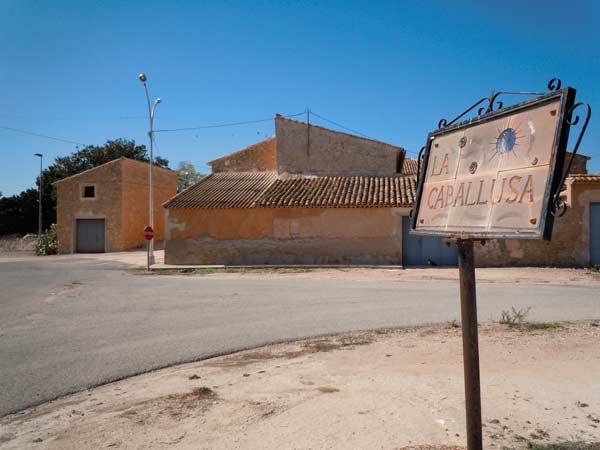


LA CABALLUSA DISTRICT
Pedáneo Dámaso Martínez Lozano
A 4,6 kilómetros del casco urbano de Pinoso encontramos La Caballusa, al suroeste del término. Son pocos vecinos, pero tienen la vitalidad de quienes viven rodeados de un entorno libre de ruido y con la tranquilidad del campo. Actualmente viven todo el año cuatro familias aunque los fines de semana se registra una mayor actividad. A finales del siglo XIX y principios del XX todas las casas hoy abandonadas se encontraban a pleno rendimiento, dado que sus moradores vivían de lo que daba el campo, recogiendo cereales, uva, aceituna, y otros productos típicos de la zona, obteniendo lo necesario para autoabastecerse y obtener ganancias por volver a cultivar. Lo mismo ocurría con la cría de animales.
To have fun after finishing the workday in the fields, the neighbors used to go dancing in other districts, provided there was no festival in La Caballusa.
However, times have changed, and the establishment of industry led to the departure of people from the district toward urban centers.
Houses and crops fell into neglect, a situation that now appears to be reversing.
The arrival of electricity and water, above all, has contributed significantly to people returning to their land, even if it is just to spend their vacations or stay for a few days.
Although more and more houses are being reoccupied, or new constructions are being built, it cannot be said that it is a very populated district.
At the end of the 1980s, only about 50 people lived in the district, both in the small nucleus that gives the district its name and in the hamlets of Casa de Tomaset, Casa de Mario, Casa de Arsenia, Casas de Pastor, Casa de Casimira, Casa del Tío Camilo, Casa de Damas, etc..
Since 1990, they have had a hermitage where they keep the image of the Virgin of the Assumption, in whose honor the festival is held.
The highlight of the festival is the pilgrimage that takes place at dawn on August 15th, from Pinoso toward the district, which features numerous faithful participants braving the heat of the season.
The effort of the day is not very excessive for some people, since, since the access road to the district was paved, many people choose the small road of La Caballusa to go walking.
But for those who do need to regain strength, at the end of the mass that follows the pilgrimage, a popular breakfast of cake and wine is offered.
Before the inauguration of the hermitage, there were some years when the La Caballusa festivities closed the summer, given that they were held at the end of August and the end of September, so as not to coincide with those of Calle Sant Roc, which have sadly disappeared, but in recent times it was changed to the day of the commemoration of the patron saint in the calendar.
Unfortunately, as has happened in the rest of the districts, the danger of security sanctions has caused the popular heifer release to disappear from the program of events, but the imagination of its neighborhood has recovered the traditional ribbon races.
From some points of the district, you can see spectacular views of the town and the Cabeço.
Its territory, at an altitude of 500 m, is crossed by the long-distance GR-7 trail, which upon arriving at La Caballusa leaves the Valencian Community to enter the neighboring Region of Murcia.
The milestone commemorates the relay in this hiking route that connects the south of Spain with Greece, passing through several countries in Europe.