

CULEBRÓN DISTRICT
Hamlet mayor: Trix Slock
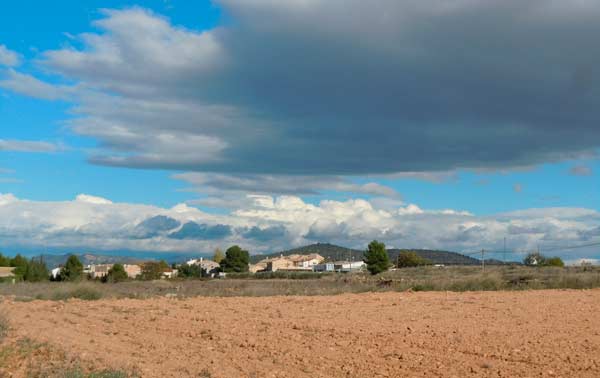
Taking the local road 3213, in the direction of Monóvar, when arriving at kilometer 17 (4.5 km from Pinoso), protected by the foothills of the Sierra del Xirivell, is the hamlet of Culebrón.
Without being a compact nucleus, there are many houses that make up the hamlet, with an approximate neighborhood of some 40 people (44 according to the 1991 census).
Like all rural areas, it has suffered the effects of depopulation, although having such a busy road as the one to Alicante pass through it has allowed many people to stay. Since 1995, that road, as it passes through the hamlet, has changed its route, so the dangers that its passage near the houses caused have been reduced. In any case, in the 60s, nearly 150 people lived there, a figure that has nothing to do with the nearly 40 current residents, who inhabit some 15 houses, although a recovery is being recorded, given that young people have chosen the hamlet to go live.
The terrain is flat and fertile, dedicated to the majority cultivation of the vineyard, producing renowned wines. In the area, there are two well-known wineries. One of them, Brotons, is dedicated to the production of very high-quality wines and oils. The other, Bodegas Alfonso, is dedicated exclusively to wines, being the first in the municipality to bottle them. On another note, there are important livestock farms in the territory, one standing out for its recent implementation and for being dedicated to a quite curious herd: ostriches.
The hamlet is also famous for having a large number of livestock farmers, who are responsible for preserving a very ancient tradition. We must highlight the introduction, a few years ago, of an ostrich farm, animals typical of other more distant areas, but which seem to have adapted well to the climatic conditions of our land.
In the group of houses that make up the hamlet, there is a small chapel, where mass is only celebrated on certain occasions, such as a wedding, a communion, or the popular festivals in honor of Saint James (San Jaime), the patron saint of the hamlet. In the past, mass was celebrated every Sunday, with the neighbors paying the priest, “according to an agreement that they grant with what best suits them” (as stated by Pasqual Madoz in his “Geographic-Statistical-Historical Dictionary,” published in the year 1846).
Due to the distribution of the houses in the nucleus that gives the hamlet its name, those located on the right side of the road—going from Pinoso towards Monóvar—are known as the “upper houses” (casas de arriba), and are the oldest, while those located on the left are the “lower houses” (casas de abajo). Behind the latter, the old road to Pinoso used to run, passing by the chapel to the Salobrar, crossing the road towards Sonca along the path of l’Enzebres, and coming out at l’Horteta. With the construction of the hamlet’s bypass, a traffic black spot in the municipality was eliminated, doing away with the sharp turn that existed and which caused so many accidents. Now, the situation has changed enough, and so many cars no longer cross the hamlet. Only a small, isolated group of houses remains on the other side.
The best-known hamlets in the district are: Casa de Carlos, Casa de los Rojos, Casas del Salobrar, or Casas de Camarillas. All of them are located in two specific areas: Camarillas and Miracielos.
With the financial support of the Department of Festivities of the Pinoso City Council, the residents of Culebrón celebrate their main festivities on July 25, under the patronage of Saint James the Apostle, with an overflowing program of activities typical of summer festivals. Although they have not always been held, the date has never been forgotten, and when there were no large celebrations, its inhabitants commemorated them in their homes. It is said that in the 1920s the first festivals began to be organized. They were carried out in 1927, but they did not have continuity. And, after the war, in the 1940s, it was tried again, without success. But that was a long time ago. The current ones are very different. The people are too. Since 1984, the inhabitants of the hamlet seem to have embraced these celebrations with more strength than before, continuing until now. Another devotion with a large following is that of Saint Joseph, an image that shares the honor of going out with the patron saint in the festival procession.
The children of several years ago (too long now) did not have to travel to Pinoso to learn. There was a school, where now we can see a well-known restaurant, which the students who could go could attend, because this studying business was not within everyone’s reach. Those who did not have much money were condemned to work. Among other teachers, Ms. Maxi Banegas and Mr. Joaquín Ruiz passed through that school.
In the area of El Salobrar, we find an example of a self-sufficient farm. The first thing that catches our attention when we arrive is the entrance path, overcoming the slope of a ravine. Upon arriving at the building, we will distinguish several doors, some with greater importance than others, which signifies who their inhabitants were. In the center, a main dwelling was articulated, that of the owners, and on the sides, there were other secondary ones, where the servants would be. All were connected. Behind were the winery areas, stables, corrals, oil mill, places for raising animals,…
The property would include enough cultivable land, given that there is an entire infrastructure for rainwater harvesting. The hill behind the house is channeled to fill two Arab cisterns, in addition to the wells and some interiors of the dwelling. But, in addition to providing water for human consumption, there is also consideration for the irrigation of the terraces, for which the channels continue further down from the house to reach a reservoir made of large stones. There is no doubt that it would be one of those such large estates that their owners would say: “See, everything you can see with your eyes, is mine.” These were other times, and other needs.