

CASAS DE PINO DISTRICT
Pedánea Beatriz Sánchez López
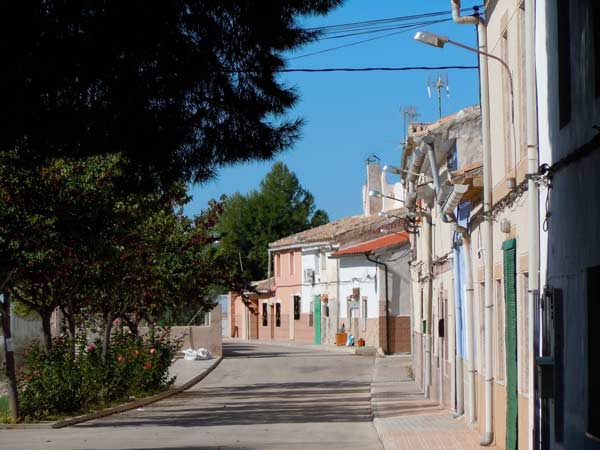
The area we know as La Cañada del Trigo is a hamlet currently shared by three municipalities: Jumilla has the largest population (with an organization of streets, church, shops, bakery, bars, school, health center, etc.); within the municipality of Abanilla, there extends a suburb known as Cases de Dalt, or Los Gabrieles; and Pinoso occupies the houses known by the name of Casas del Pi (Cañada del Trigo of Pinoso).
A stone more than 200 years old marks, in the Sierra de la Cruz, the municipal and provincial division, although the inscription that faces the municipality of Pinoso says MONOVAR.
The houses that belong to Pinoso are scattered, creating small hamlets of two or three dwellings, around the farmland that produces wine, oil, wheat (much less now), almonds, and other products.
Although more than a century ago more than 20 people lived there, and in 1960 there were about 67 inhabitants, according to the 1991 census, today about fifteen inhabitants live there, many of them farm workers. Their children, in most cases, do not want to follow in their parents’ footsteps and, those who already work, do so in Pinoso, in the footwear factories.
The 7 km that separate the houses from the town center are nothing, especially because almost all the neighbors, and even more so if they are young, already have a driver’s license.
The most important hamlets are known by old names: Casa de los Novelderos, Casas del Tio Pio, Caseta de Quito, Casa de Jover, and, above all, the Casas del Pi, among others, tell us things about which families inhabited them or what particularity the house or its surroundings had. Now hardly anyone from those characters to whom those names refer lives there anymore. For quite a few years, the original people went to live in the part of Jumilla or in the town of Pinoso, looking for comforts that living separated from the urban center did not provide them.
The people who now occupy the houses began to do so looking for tranquility, more than thirty years ago, and now they form a very close-knit neighborhood, which has adapted to the traditions and customs of the entire area. In recent years, new neighbors have settled in, with the construction of newly built houses, which have nothing to do with the style typical of these lands. For the most part, they are foreigners who have chosen our inland area to live in tranquility.
Although each part of La Cañada del Trigo must carry out its administrative procedures at their respective town halls, they share all kinds of contact: they go to mass in the same church, collaborate in the organization of the festivities, which are celebrated in August, and take their wine to the “Virgen del Remedio” Cooperative Winery, all in the part belonging to Jumilla.
This climate of collaboration is not the result of these times. Already in 1917, an agreement was created among everyone to make a well to draw water to irrigate the crops, a well known by the name of “Pozo de la Excavación.”
Returning to our territory, the hamlet is well connected to Pinoso by a road, built a few years ago by taking advantage of an old path, which shortened the distances that separated these neighbors from the rest of the municipality. Perhaps for that very reason, people have returned to inhabit the houses, especially on weekends, although many of these houses have new owners, even including foreign presence. This road is sufficiently busy, if we take into account that many of the inhabitants of La Cañada del Trigo (including all the parts previously mentioned) work in Pinoso or go to the town very often, which they say they feel more identified with.
Currently, a mountain range near the houses has been dedicated to an aggregate quarry, which began in 1991 and is creating around it an entire infrastructure of good roads, which the neighbors have known how to take advantage of very well. The negative note of this initiative is that the area is suffering a rapid environmental degradation that is not looked upon favorably, given that many neighbors remember the good times spent in these mountains, and now they see how trucks loaded with earth, which is mainly dedicated to the construction sector, do not stop passing by.
Its inhabitants have always spoken Valencian. But in recent years this has changed a lot, since many of the dwellings have changed owners, who for the most part speak Spanish. However, the youngest, although they must take classes in Spanish at school, have not lost their original speech, precisely because of their regular contact with people from our town.
Casas del Pi has never held regular festivities. There is a record of having held some when the Spanish Civil War ended, as a sign of gratitude, because the area had been one of the most punished. Some older people have told us that the party was very big. It even included the presence of the Mayor of Pinoso and, with him, a crowd of uniformed Falangists, who participated in a field mass, celebrated under the pine tree that gives the hamlet its name.
Regarding more recent festivities, we must speak of the fact that the new residents of the houses that make up the hamlet tried to organize them, although the attempt did not catch on. The initiative was carried out by one of its neighbors, known as “El Marqués,” a few years in which the Virgin of Fatima was celebrated, and which the neighbors call the “Virgin of the Pine,” a devotion that also exists in the Canary Islands. But those festivities disappeared in the late 1970s. Perhaps because the neighbors were used to participating in the festivities of the Jumilla part (which are celebrated around August 15) and still continue to do so.
Going back