

Casas de Ibáñez District (Les Casetes)
Isabel Cano Méndez, Hamlet Mayor.
Se trata de una pedanía diseminada, pero con un núcleo concentrado en torno a la carretera de Jumilla. Precisely, the most important population entity is located right on the provincial border. There are houses that already belong to the region of Murcia.
It is characterized by its typical caves, in some of which dances were held in the past. Now some of them have been deeply transformed to adapt to modern times. They can still be seen just as they were excavated, maintaining their charm, but some have collapsed or are on the verge of doing so.
Located about 3.5 km from the town center, it has several hamlets: Casica de la Balsa, Casa Monsenal (or Mosen Navidad)—although it no longer exists today, after being destroyed by the new owners of the adjacent lands, to which they have added the plot that the house occupied, with its wineries and stables for animals—, Casa Cotoño (or de la Tía Cotoña), el Sequer (the hamlet closest to the town), or the nucleus of the Casas de Ibáñez, which gives its name to the district. In addition, recently, small labor and country houses have been built, taking advantage of the tranquility of the area.
As in the case of La Cañada del Trigo, on the other side of the border there are also other Casas de Ibáñez, within the municipality of Jumilla. It seems as if, in the land distributions that were carried out when the provincial borders were established, the situation of these population centers, with their customs, their brotherhood relationships, etc., had not been taken into account.
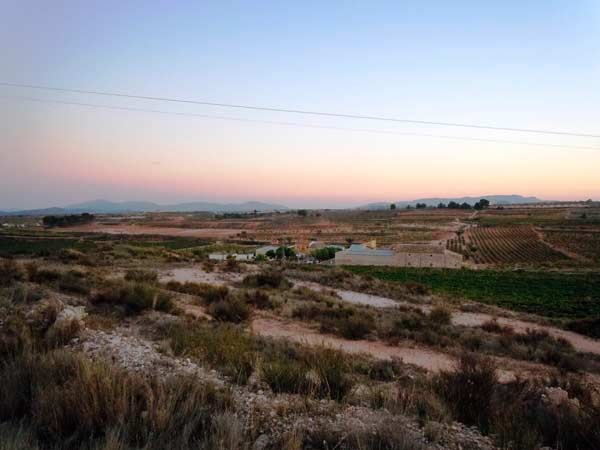
The district is located at an altitude of 495 m surrounded by abundant vineyards, although there is also a presence of other crops. From the district, you can see beautiful views of Pinoso and its surroundings. The Cabeço appears as the protector of the village, which nestles in its foothills.
A few years ago, near the main houses, there was a motocross circuit, where several competitions were held in the late 70s and early 80s. Ahora ya no queda nada de eso. In ’98, it meant its definitive disappearance from the face of our municipality. Fans of the motor world surely remember the exciting trials, with the jumps of the motorcycles as they climbed up the steep slopes of the route.
The agricultural landscape of the surroundings is very varied. In addition to the vineyards that populate most of the land, there are fruit crops around the Jumilla road, which crosses the district, or the olive and almond trees that populate its mountains. In the 70s, to alleviate the lack of water for irrigation in the area, two reservoirs were built in the district, one of them near the hamlet of El Sequer, while the other is near the core of the rural area.
Currently, there are many families who have a house in Casas de Ibáñez, although, for the most part, they live in other towns and go to the house they have in the district to enjoy the weekend away from the noise of the town or the city. An interesting point of this district is its caves, many of them inhabited.
In recent years, its residents have seen drinking water reach their homes, a garden has been built, street lighting has been installed, and the surrounding rural roads have improved considerably… Time always brings improvements.
In the area of El Sequé, we find one of the few large 18th-century houses preserved in the municipality, although, if it is not remedied, it runs the risk of falling down. It is the Casa de la Pava, or Poveda house, a family that also had other constructions in the surroundings, such as their well-known orchard, an enclosed area in which they cultivated the products they needed to be self-sufficient. In the hamlet, from the outside, one can observe the decoration of the upper rooms, proof of the refinement the family enjoyed. On the facade, the importance of the work is also noticeable, with cornices and grand balconies, framed windows, in the style of the baroque houses that could be seen at that time in the large cities of the provinces of Alicante and Murcia. In addition, we also find a tile altarpiece dedicated to the Holy Trinity, a devotion to which the owners would ask for protection.
A street below the hamlet we described, today, a guesthouse-restaurant has been opened that prepares traditional lunches and dinners, in addition to carrying out recreational activities. Its owners have made a strong commitment to rural tourism, with initiatives as imaginative as the possibility of taking what they have called the “Ruta de Jaume el Barbut” (Route of Jaume the Bearded), in which the visitor enjoys the landscape of the foothills of the Sierra del Carxe, which this character used to travel while up to his old tricks or hiding when he was being pursued.
Since we are talking about historical figures, due to some findings made in certain documents, the person who subscribes these words thinks that this hamlet is what is called on the maps of the 16th, 17th, and 18th centuries as Casas de Costa or Casas de Acoste, given that on some 19th-century maps two places appear at the same time, with the names of Casas de Costa and Pinoso, which would suggest that, in origin, the district we are dealing with would be older than the current urban center of El Pinoso. But these are theories that would need to be verified.
Regarding the festivities, they hold them in honor of the Virgen del Perpetuo Socorro, although some years they cannot hold them and they join the neighborhood on the other side of the border between the provinces to celebrate the festival in ‘Alberquilla. When the festival is held, it takes place in the garden that the City Council built in the mid-90s, near the net.